Every Scar Tells a Season: How to Read the Growth Rings of Your Own Life
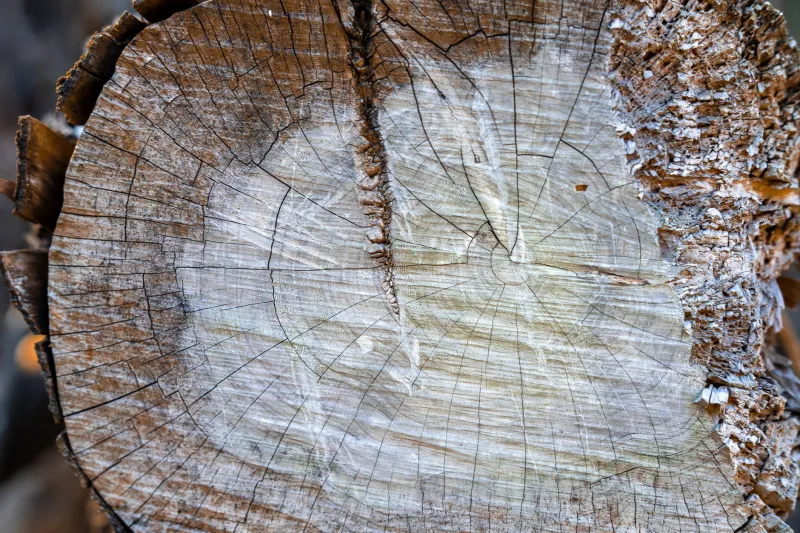
Slice a tree trunk clean across and you'll see something that looks almost like a fingerprint — concentric circles radiating outward from the center, each one a year of living. Scientists who study these patterns, dendrochronologists, can look at that cross-section and read the tree's entire biography without a single word being spoken. A thin ring? Hard year. Drought, maybe, or a brutal winter. A wide, lush ring? Plenty of rain, plenty of light, everything clicking into place at once.
Here's the thing nobody tells you in school: you have rings too.
Not the kind you can see with a saw, obviously. But the architecture of your life — the decisions you made, the losses you absorbed, the relationships that changed you, the seasons you barely survived — all of it left a mark. And if you know how to look, you can read your own timeline the same way a scientist reads a tree. Not to dwell on the hard years, but to understand what they built in you.
What Dendrochronology Actually Is (And Why It Matters Here)
Dendrochronology is the scientific method of dating and analyzing tree rings to study past climate and environmental conditions. A single old-growth tree can hold hundreds of years of climate data in its trunk. Researchers have used it to study ancient droughts, volcanic winters, even the effects of wars on regional ecosystems.
The principle is elegant: growth responds to conditions. When resources are plentiful, the tree expands generously. When they're scarce, it conserves, pulling inward, prioritizing survival over expansion. Neither response is a failure. Both are intelligence.
Your life works on the same logic. You didn't grow at a steady, predictable rate. Nobody does. You expanded in some years and contracted in others, and both of those movements shaped the person reading this right now.
Finding Your Rings: The Events That Literally Changed Your Trajectory
Start by thinking in chapters, not years. Most people's lives don't divide neatly by calendar — they divide by events. The move across the country. The relationship that ended badly. The job that finally clicked. The year someone you loved got sick. The summer everything felt possible.
Those are your rings.
Grab a piece of paper if you want to do this properly. Draw a circle in the middle — that's you, early. Now start adding rings outward, one for each major chapter or turning point. Don't overthink the order. Just let them surface.
What you're looking for isn't a highlight reel. You're looking for the moments that changed the grain of who you are. The experiences that, had they gone differently, would have produced a genuinely different person.
Some of those moments will be obvious. Others will surprise you. A lot of people discover, doing this exercise, that their thinnest rings — their hardest years — produced some of their densest internal structure. Just like a drought-stressed tree, which often develops tighter, harder wood that's more resistant to rot and insects than the wood grown in easy seasons.
The Thin Rings Aren't What You Think
We tend to look back at our difficult periods with a mix of shame and relief — shame that we struggled, relief that it's over. But dendrochronologists don't see thin rings as failures. They see them as data. Specifically, they see them as evidence of resilience, of a system that adapted under pressure and kept going.
Think about your own thin rings. The year the money ran out. The stretch when you were isolated, or grieving, or completely lost about what came next. What did you actually do during those periods? Most people, when they really examine it, find that their hardest seasons produced their most creative problem-solving, their deepest relationships, and their clearest sense of what they actually valued.
Hardship doesn't automatically make people stronger — that's a myth worth retiring. But hardship survived, processed, and integrated? That's a different story. That's where the density comes from.
Reading the Wide Rings: What Boom Seasons Actually Reveal
Flip the lens. Your wide rings — the seasons of expansion, momentum, and growth — are worth studying just as carefully, and for different reasons.
When did you grow fastest? What conditions were present? Who was around you? What were you doing with your time and energy?
For a lot of people, their widest rings share a few common ingredients: a sense of purpose or direction, at least one relationship that felt genuinely supportive, some degree of challenge (not crisis, but stretch), and enough stability to take risks.
This matters because those conditions aren't magic. They're reproducible. If you can identify what made your boom seasons possible, you have a rough blueprint for creating more of them — or at least for recognizing when the conditions are aligning again.
The Ring You're Growing Right Now
Here's the part that tends to catch people off guard: you're in the middle of a ring right now. This year, this season, this chapter — it's being written in real time, and you won't be able to read it clearly until you're looking back from the outside.
That's both humbling and kind of freeing. You don't have to know what this year means yet. You just have to keep growing.
What you can do is pay attention to the conditions you're operating in. Are you in a drought? Are you getting enough light — enough support, enough challenge, enough rest? Are you surrounded by the kind of relationships that help you grow wide, or ones that keep you contracted and cautious?
A tree can't choose its rainfall. You have more agency than that. Not total control — nobody gets that — but real influence over the conditions you place yourself in and the company you keep while you grow.
What Your Rings Say About What's Coming
Dendrochronologists use tree ring data to make predictions. If a tree survived a particular kind of stress before, the ring record shows how it responded and what it built in the process. That historical data informs projections about future resilience.
Your personal ring record does the same thing, if you let it.
Look back at the hardest rings you've grown through. You are still here. That's not a small thing. The capacity you built in those years — the problem-solving, the tolerance for uncertainty, the knowledge that you can survive things that feel unsurvivable — that capacity doesn't disappear when conditions improve. It becomes part of your structure. It becomes the density that holds you upright when the next storm shows up.
And there will be another storm. That's not pessimism — that's just how seasons work.
But you've got rings now that you didn't have before. You've got history in your grain. And if you take the time to actually read it, you might find that you're a lot more built for what's coming than you give yourself credit for.
The rings don't lie. Neither does yours. Take the time to read what you've already survived — it might be the most honest map you have for what comes next.