Your Body Was Built for Chaos: The Science of Letting Your Nervous System Run Wild
Somewhere between your morning cortisol supplement, your blue-light-blocking glasses, and the app that reminds you to breathe every forty-five minutes, something went sideways. Not with your routine — your routine is probably immaculate. Something went sideways with the deeper, older machinery running underneath all of it.
Your nervous system is ancient. We're talking hundreds of millions of years of evolutionary engineering, calibrated not for predictability but for wildness — for weather that changed without warning, for meals that didn't arrive on schedule, for days that were sometimes boring and sometimes terrifying and rarely the same twice. And now we've dropped that same system into an existence so controlled, so optimized, so relentlessly smoothed-out that it's quietly losing its mind.
The emerging science around what some researchers are calling "nervous system rewilding" suggests that the anxiety epidemic, the burnout crisis, the collective sense that something is deeply off — these aren't just psychological problems. They're biological ones. And the prescription isn't another protocol. It's a little more wilderness.
The Optimization Trap
Here's the paradox nobody talks about: the more aggressively we manage our stress, the worse our stress response often gets.
Your autonomic nervous system — the branch that handles your fight-or-flight and rest-and-digest functions — was designed to flex. It's supposed to spike and recover, activate and settle, push hard and then go quiet. Think of it less like a thermostat you set and forget, and more like a muscle that needs actual exercise, including the uncomfortable kind.
When we eliminate every source of unpredictability from our lives, we're essentially putting that muscle in a cast. It atrophies. The technical term researchers use is "autonomic inflexibility" — a reduced capacity to shift between nervous system states efficiently. And autonomic inflexibility is showing up as a significant factor in everything from cardiovascular disease to depression to immune dysfunction.
Dr. Stephen Porges, whose polyvagal theory has reshaped how we understand the nervous system, has spent decades arguing that humans need cues of safety to regulate — but crucially, we also need contrast. We need to have experienced something that wasn't safe in order for safety to register as meaningful. A life with no edges doesn't feel secure. It just feels flat.
What "Going Feral" Actually Means
Before you picture yourself quitting your job and living in a yurt in Montana — though no judgment if that's the direction — let's be clear about what nervous system rewilding actually looks like in practice. It's not extreme. It's not reckless. It's not a personality type.
It's about reintroducing genuine uncertainty into your daily life in doses your system can learn from.
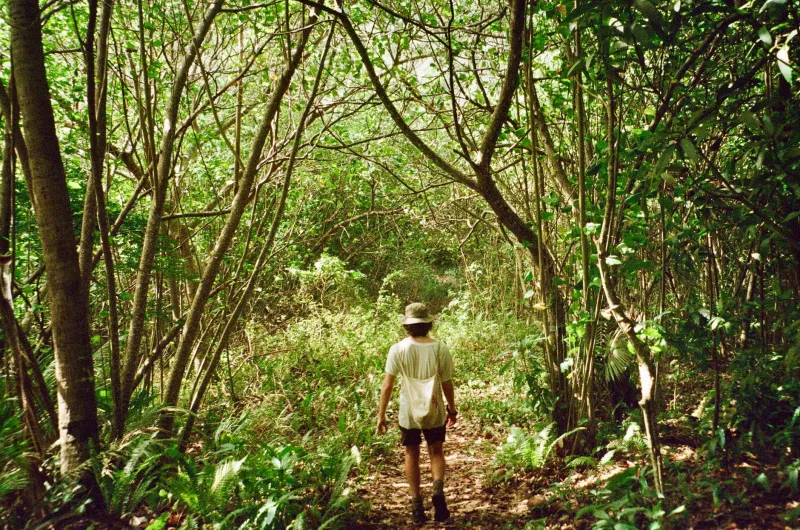
Nature does this automatically, which is one big reason spending time outdoors has such a measurable effect on stress hormones, heart rate variability, and inflammatory markers. A walk in the woods isn't just pleasant — it's neurologically complex. The ground is uneven. The light shifts. There are sounds you can't immediately identify. Your brain has to stay present and slightly alert in a way that a treadmill in a gym simply doesn't require. That low-grade, manageable unpredictability is exactly the kind of input your nervous system is starving for.
But rewilding doesn't have to happen in a forest. It can look like:
- Eating meals without checking the time, letting actual hunger cues guide you instead of the clock
- Taking a different route home without using GPS, tolerating the mild discomfort of not knowing exactly where you are
- Sitting outside in actual weather — not just the nice days — and letting your body respond to cold, wind, or heat without immediately retreating
- Leaving unstructured time truly unstructured, resisting the urge to fill it with content or productivity
- Engaging with genuine social uncertainty — starting a conversation with a stranger, joining something new where you don't know anyone
None of these are dramatic. All of them are, to a nervous system raised on optimization culture, quietly radical.
Seasonal Rhythms and the Body That Forgot Winter
One of the most overlooked forms of nervous system dysregulation is our total disconnection from seasonal change. Americans, especially those in climate-controlled homes and offices, experience something close to perpetual summer — consistent temperatures, consistent light exposure, consistent food availability. And while that sounds luxurious, it's physiologically weird.
Our bodies evolved to slow down in winter. Melatonin production shifts. Appetite changes. Energy naturally draws inward. These aren't bugs in the system — they're features. The nervous system uses seasonal contrast as a kind of reset, a long exhale after the high-output months.
When we override that rhythm with artificial light, year-round produce availability, and the cultural pressure to maintain peak productivity in January, we're essentially asking the system to run without ever rebooting. Is it any wonder so many of us hit a wall around February that no amount of cold plunging seems to fix?
Honoring seasonal rhythms doesn't require moving off-grid. It might mean letting yourself sleep a little longer in December without guilt. Eating more warming, heavier foods in winter rather than forcing yourself through salads. Spending even ten minutes outside each morning to anchor your circadian rhythm to actual daylight. Small calibrations, but they speak the language your nervous system has been waiting to hear.
Risk, Reward, and the Nervous System's Favorite Drug
There's another piece of this that tends to make people uncomfortable: your nervous system needs risk. Not danger — risk. The distinction matters.
Risk involves genuine uncertainty about an outcome you care about. It triggers a specific neurochemical cascade — a controlled release of norepinephrine and dopamine — that, when followed by successful navigation, actually builds resilience at the cellular level. This is why kids who play in unstructured outdoor environments, including ones with some physical risk, consistently show better emotional regulation than kids raised in entirely padded, supervised spaces. The nervous system learns from navigating uncertainty. That's the whole point.
For adults, this might mean taking on a project where failure is genuinely possible. Trying something physical and new — rock climbing, surfing, a pottery class where you're visibly bad at first. Having an honest conversation you've been avoiding. These aren't adrenaline-sport prescriptions. They're invitations to let your nervous system do what it was built to do: assess, adapt, and grow.
Coming Back to Your Wild Baseline
The big trees that inspired this site didn't grow by being managed. They grew by being present — responsive to drought and storm and season, shaped by forces they couldn't control and didn't try to. Their rings tell the whole story: the lean years and the abundant ones, the fires they survived, the winters that slowed them down and the springs that pushed them upward again.
Your nervous system has its own rings. It carries the record of every time it was allowed to flex and recover, every risk that paid off, every season it was given permission to rest. The goal isn't to make that record smooth and uniform. The goal is to make it rich.
So maybe the next step in your wellness journey isn't another supplement or another protocol. Maybe it's a walk in weather that isn't perfect. A meal without a timer. An afternoon with no plan and no content to fill it.
Maybe it's just giving your ancient, wild, magnificently over-engineered body a little room to remember what it knows.