When Nothing Seems to Be Happening, Everything Is: The Hidden Power of Your Stalled Years
There's a particular kind of frustration that doesn't get talked about enough. It's not burnout. It's not failure. It's the slow, grinding feeling of being stuck — of looking around at your life and thinking, shouldn't something have changed by now?
Maybe you've been in the same job for three years and the promotion hasn't come. Maybe your creative project has been sitting half-finished on your laptop since last spring. Maybe you started therapy, or a new workout routine, or a meditation practice, and you're doing the work — but you can't feel it working. You're not moving backward, but you're not exactly surging forward either.
You're in a thin ring year. And that might be exactly where you need to be.
What Dendrochronologists Know That We Don't
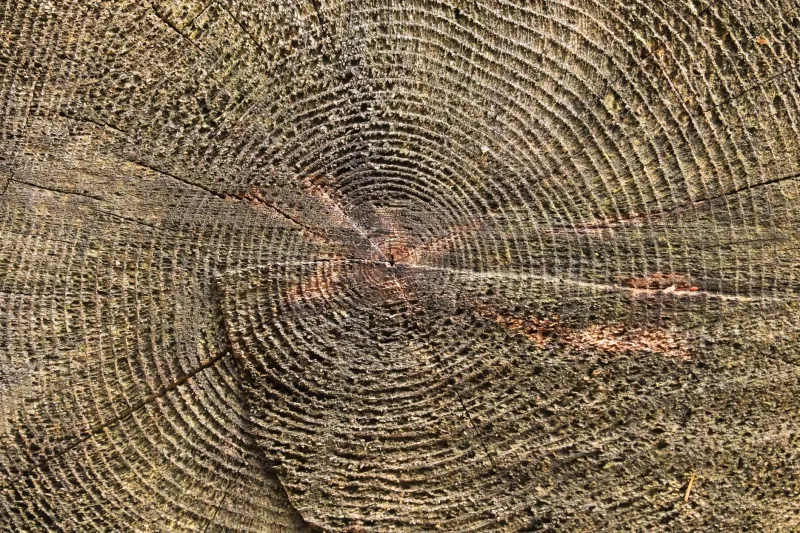
Dendrochronology — the science of reading tree rings — is one of those fields that sounds niche until you realize it tells the story of basically everything. Drought, disease, wildfire, climate shifts. Scientists can crack open a cross-section of a centuries-old tree and read its entire biography in concentric circles.
Here's the part most people don't know: thin rings aren't signs of failure. They're signs of stress response. When a tree faces drought, cold snaps, or nutrient scarcity, it produces a denser, tighter ring. Less visible growth on the outside, but the wood itself becomes harder, more compact, more resistant to damage. Foresters will tell you that the tightest-grained wood — the kind prized for instruments, fine furniture, structural beams — often comes from trees that grew slowly under difficult conditions.
The wide, fast rings from boom years? Beautiful, yes. But structurally, they're softer.
Nature has been running this experiment for millions of years. And it keeps arriving at the same conclusion: slow, pressured growth builds something that fast growth simply can't.
The Psychology of Plateau
Western culture — especially American culture — has a complicated relationship with stillness. We celebrate the glow-up. The pivot. The comeback arc. We love a transformation montage. What we're not great at is sitting inside the part of the story where the music hasn't started yet.
Psychologists who study human development have a name for what happens during these quiet periods: consolidation. When you're not visibly progressing, your brain is often integrating everything you've already learned. It's reorganizing neural pathways, stress-testing new beliefs, quietly dismantling old ones. Researchers studying skill acquisition have documented this for decades — the plateau isn't the absence of learning, it's the phase where learning goes underground.
Think about language learners who hit a wall around the intermediate stage. Or athletes whose performance seems to flatline right before a major leap. Or entrepreneurs who spend eighteen months building infrastructure that nobody sees before anything takes off. The plateau precedes the breakthrough. Almost every time.
The problem isn't the plateau itself. The problem is what we do when we can't see progress: we panic, we quit, we pivot too early, we decide the whole thing isn't working. We abandon the tree before the ring finishes forming.
What Gets Built When Nothing Gets Built
So what's actually happening during a stalled year? More than you'd think.
Resilience is being stress-tested. When things aren't going your way and you keep showing up anyway, you're building the psychological equivalent of dense wood grain. You're proving to yourself — not just intellectually but experientially — that you can tolerate discomfort without collapsing. That's not a small thing. That's foundational.
Identity is being renegotiated. A lot of plateau periods are actually transition periods in disguise. The person you were at the beginning of the stuck season isn't quite who you'll be at the end of it. Values shift. Priorities clarify. What used to feel urgent starts to feel optional. This kind of internal reorganization is slow, invisible, and genuinely important — but it doesn't show up on any productivity tracker.
Perspective is recalibrating. Distance has a way of doing what effort can't. Some problems don't get solved by pushing harder. They get solved by letting time pass, letting emotions settle, letting new information arrive. The stalled year creates the space for that to happen, even when it doesn't feel like anything useful is going on.
How to Actually Live Inside a Thin Ring Year
Knowing that stalled years are secretly productive is one thing. Living inside one without losing your mind is another. A few things that actually help:
Stop measuring with the wrong ruler. If your only metric is external output — promotions, finished projects, visible results — you will always feel behind during a consolidation phase. Try measuring inputs instead. Are you still showing up? Still curious? Still doing the small, unglamorous things that don't make for good Instagram content? That's the ring forming.
Find the signal in the discomfort. Stagnation and stuckness often feel identical from the inside, but they're different. True stagnation usually comes with a sense of numbness or avoidance — you're not just not moving, you're actively not looking at something. A growth plateau, by contrast, often feels like effortful waiting. Like you're doing everything right and the results just haven't arrived yet. Pay attention to which one you're actually in.
Resist the urge to blow everything up. This is the big one. When we're uncomfortable with stillness, we manufacture drama to create the feeling of movement. We quit, we blow up relationships, we make impulsive career changes, we start over from scratch — not because starting over is right, but because anything feels better than sitting in the plateau. Before you torch it all, ask yourself honestly: is this a genuine signal to change, or is this just discomfort looking for an exit?
Give the ring time to close. Tree rings don't form in a weekend. Neither do the internal shifts that matter most. Some of the most significant personal changes in your life will only be visible in retrospect — you'll look back from two years out and realize that the season that felt like nothing was actually the season that changed everything.
The Trees That Survived the Hard Years
There's an old bristlecone pine in the White Mountains of California that's nearly 5,000 years old. It has survived ice ages, droughts, lightning strikes, and centuries of brutal wind. Scientists who've studied its rings say many of its years produced almost no measurable growth at all.
And yet there it stands. One of the oldest living organisms on the planet.
Your stalled years aren't erasing your story. They're writing some of its most important chapters — the ones that happen between the lines, in the density of the wood itself, in the quiet accumulation of something that doesn't show up until it has to.
The ring is still forming. Give it time.