The Loneliness of the Self-Made Myth: What Underground Fungal Networks Reveal About Your Brain
We love a good bootstraps story in America. The lone genius in a garage. The entrepreneur who outworked everyone. The person who needed nobody and built something anyway. It's practically a national religion — this idea that true strength means going it alone.
But walk into an old-growth forest and that story starts to fall apart pretty fast.
Under your feet, invisible and almost incomprehensibly complex, a living network made of fungal threads called mycorrhizae connects tree to tree, root to root. It carries sugar, phosphorus, water, and chemical distress signals across acres of forest floor. A Douglas fir struggling in the shade gets fed by its neighbors. A tree under pest attack sends out a chemical SOS that ripples through the web, triggering defensive responses in trees that haven't even been touched yet.
The forest isn't a collection of individual competitors. It's a community that shares its resources and its intelligence. And here's the part that should stop you mid-scroll: your brain may be wired the exact same way.
What Mycorrhizal Networks Actually Do
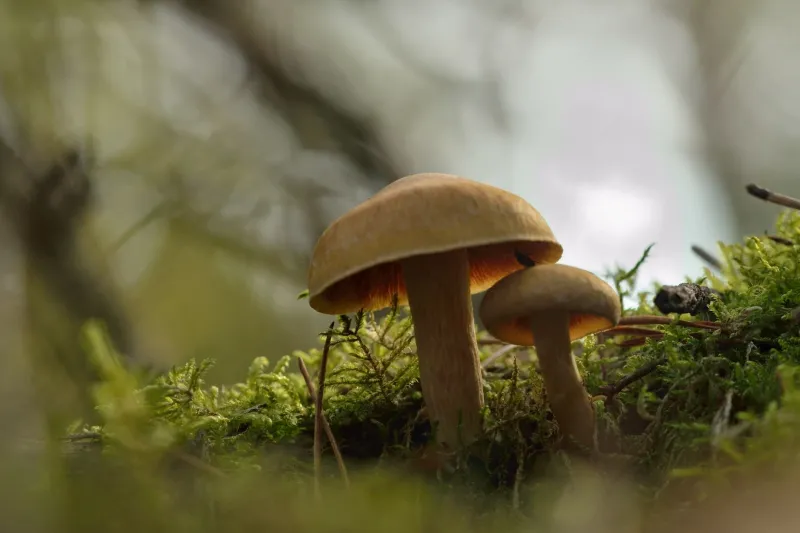
The fungi involved in these underground networks — mycorrhizae — don't just hang around passively. They actively form symbiotic relationships with tree roots, extending the reach of those roots by orders of magnitude in exchange for a cut of the tree's photosynthesis output. It's a trade. A partnership.
What emerges from millions of these individual partnerships is something researchers have started calling the "Wood Wide Web" — a decentralized, self-regulating information and resource exchange that has no central command. Ecologist Suzanne Simard's decades of research in Canadian forests showed that older "mother trees" funnel disproportionate amounts of carbon to younger seedlings, especially their own kin. When a mother tree is dying, she actually ramps up the transfer of resources to surrounding trees, essentially passing on what she's accumulated.
That's not just biology. That's generosity encoded into the ecosystem.
Your Brain Is Not a Solo Instrument
Here's where it gets personal. Neuroscience has been quietly dismantling the myth of the independent mind for years now, and the findings are hard to ignore.
Human brains are what researchers call "social organs." They evolved not for solitary processing but for coordinated group living. The prefrontal cortex — the part responsible for decision-making, planning, and emotional regulation — literally functions differently depending on whether you feel socially connected or isolated. Studies out of the University of Chicago found that chronic loneliness triggers a neurological threat response similar to physical pain. Your brain reads social isolation as danger.
When you're embedded in a network of mutual reliance, your nervous system downregulates stress hormones. Your hippocampus — central to memory and learning — operates more efficiently. Your default mode network, which handles things like self-reflection and future planning, runs cleaner when it's regularly synced with other minds through conversation, collaboration, and shared experience.
In other words, your brain is not optimized for independence. It's optimized for interdependence.
The Productivity Trap of Going It Alone
This matters practically, not just philosophically. The self-sufficiency ideal that pervades American work culture — the "I'll figure it out myself," "I don't need to ask for help" mentality — is, from a cognitive performance standpoint, actively counterproductive.
Research on expertise and problem-solving consistently shows that people who maintain strong networks of trusted collaborators outperform isolated high performers over time. Not because they're smarter individually, but because they're tapping into distributed intelligence. They're running a mycorrhizal network instead of a single root system.
Ask for help, and your brain processes the problem from a new angle. Explain your thinking to someone else, and you catch errors you'd have missed alone. Receive honest feedback, and you adapt faster. These aren't soft skills. They're cognitive upgrades that only become available when you stop treating self-sufficiency as a virtue.
There's also the stress load to consider. The mental overhead of believing you have to handle everything solo is enormous. That persistent background hum of "I can't let anyone see I'm struggling" is a drain on working memory and executive function. It's the cognitive equivalent of running too many apps in the background — everything slows down.
Emotional Resilience Grows in Networks, Not Isolation
Forests are more resilient than monocultures. Anyone who's watched a single-species crop get leveled by one disease knows this. Diversity and connection create redundancy — when one node in the network struggles, others compensate.
Human emotional resilience works the same way. People who bounce back from adversity aren't typically the most stoic or self-contained. They're the ones with the deepest relational roots. They have people to call at 11 p.m. They have communities that notice when they go quiet. They have mentors who've weathered similar storms and can pass along hard-won knowledge — just like Simard's mother trees.
The research on post-traumatic growth — the phenomenon where people emerge from hardship genuinely stronger and more expansive — consistently points to social connection as a central ingredient. It's not that suffering alone builds character. It's that processing difficulty within a network of support transforms it.
Rethinking What Strength Actually Looks Like
None of this means that solitude is bad, or that boundaries aren't important, or that you should outsource your inner life to whoever's nearby. Trees in the mycorrhizal network still do their own photosynthesis. They still grow their own rings. Individual growth and collective connection aren't opposites.
But there's a difference between healthy solitude and the performance of self-sufficiency. One restores you. The other is a slow leak.
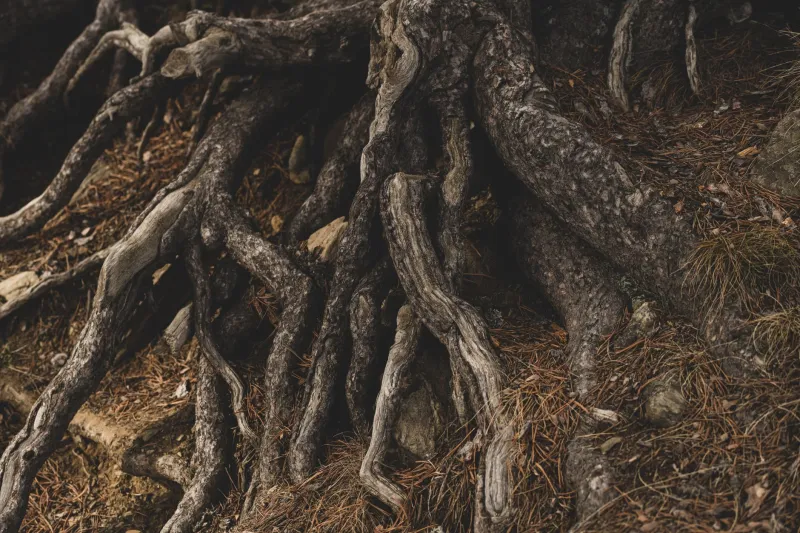
The strongest trees in any forest are almost always the ones most deeply integrated into the network around them. They've been fed and supported and challenged by their neighbors for decades. Their root systems are entangled with hundreds of other organisms. They didn't grow tall by refusing help — they grew tall because the whole forest was invested in their growth.
That's not weakness. That's the actual architecture of resilience.
Growing Into Connection
So what does this look like in real life? It looks like letting your coworker's expertise complement yours instead of threatening you. It looks like actually telling your friends when things are hard. It looks like building professional relationships that are genuinely reciprocal rather than transactional. It looks like accepting that asking for help isn't a gap in your capability — it's an expansion of it.
The mycorrhizal network doesn't care about credit. It doesn't keep score. It just moves resources toward where they're needed, and the whole forest thrives because of it.
Maybe the most radical thing you can do in a culture obsessed with individual achievement is to let yourself be part of something bigger. To extend your roots toward others. To receive what's offered and pass along what you have.
The trees have been doing this for 400 million years. Your brain has been waiting to do it your whole life.
Stop making it work alone.