Nobody Grows Alone: What Forest Canopies Reveal About Mentorship and Success
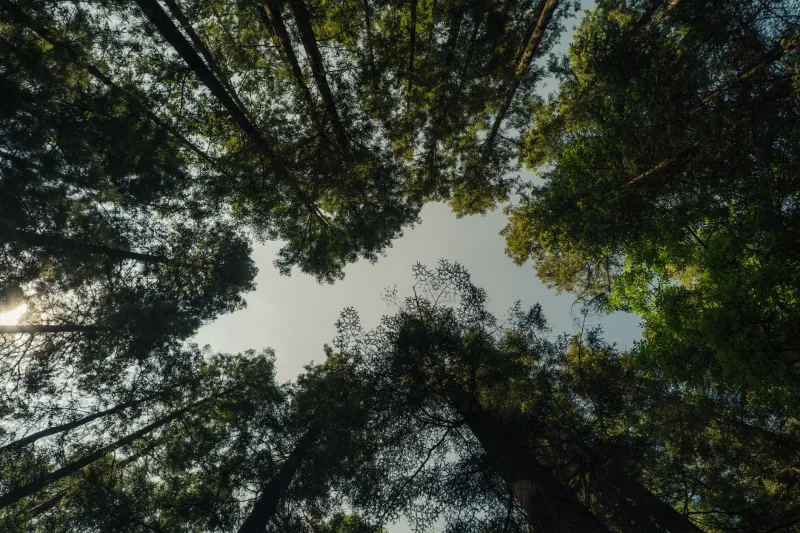
Walk into any old-growth forest in the Pacific Northwest and look up. What you'll see is a layered world — massive Douglas firs reaching toward the sky, mid-story maples filling in the gaps, and young saplings threading their way toward whatever light they can find. Every single layer depends on the others. The big trees create the conditions that let the smaller ones survive. The smaller ones, in turn, eventually become the canopy themselves.
Now think about the last time someone told you they were "self-made."
It's one of the most persistent stories in American culture — the lone genius, the bootstrapped entrepreneur, the person who clawed their way up without anyone's help. It's a compelling story. It's also, if we're being honest, almost never true. And the forest has been showing us why for a very long time.
What the Canopy Actually Does
In a healthy forest, the canopy isn't just the pretty top layer. It's a functional system. Tall trees moderate temperature, regulate moisture, and filter light so that what reaches the forest floor is diffused, workable, and life-giving rather than scorching and destructive. Young trees growing beneath a canopy are protected from the harshest extremes while still getting enough light to photosynthesize and grow.
Ecologists call this facilitation — the process by which established plants actually improve the conditions for those coming up behind them. It's not charity. It's not competition. It's something more nuanced: a kind of structural generosity built into the system itself.
Human careers and communities work the same way, even if we don't always name it that clearly. The people who've gone before you — who've already taken the hits, learned the terrain, and figured out how to survive the brutal seasons — are your canopy. Their experience casts a kind of shade that, rather than blocking your growth, actually makes it possible.
The Problem With Glorifying the Solo Climb
American culture has a complicated relationship with mentorship. We celebrate independence. We lionize the underdog. We love a comeback story where someone figures it all out on their own. But when researchers actually study high-achieving, deeply fulfilled individuals — the ones who describe their lives as meaningful, not just successful — a consistent pattern shows up: they are almost never isolated.
They have mentors. They have peers. And crucially, they have people they're actively helping grow.
A 2019 study from the American Psychological Association found that people who engaged in mentoring relationships — both as mentors and mentees — reported significantly higher levels of purpose and life satisfaction than those who operated primarily alone. That's not just a career stat. That's a quality-of-life finding.
The forest doesn't lie. The trees that grow in isolation — out in a field, away from the community of the forest — are often structurally weaker. They may be wide, but they're not as resilient. They haven't been shaped by the gentle pressure of growing alongside others. They haven't benefited from the shared root networks and fungal communication systems that make forest trees so remarkably robust.
Same goes for us.
Finding Your Canopy
So how do you actually find mentors in a world that doesn't always make that easy? The good news is it doesn't have to look like a formal mentorship program with matching algorithms and quarterly check-ins (though those can work too).
Start by identifying the people in your field, your community, or even your extended social circle who are living something close to the life you want to build. Not perfect — just further along. People who've navigated terrain you're still approaching. Then, rather than asking them to "be your mentor" (a request that can feel weirdly heavy), just ask for a single conversation. Ask one specific question. Be curious about their experience rather than hungry for their advice.
The best mentorship relationships grow organically, the way the best trees do — slowly, with good conditions and a little patience.
Also worth noting: your canopy doesn't have to be above you professionally. Some of the most powerful mentors are people who are older in life experience, even if they work in a completely different industry. A retired teacher, a grandparent who built a business from scratch, a neighbor who's been through loss and come out the other side with their sense of humor intact — these people have something real to offer. Don't overlook them because they don't have the right LinkedIn title.
The Part We Skip: Growing Down
Here's where it gets interesting, and where a lot of people check out of the conversation.
In the forest, the canopy trees don't just receive — they give. Their fallen leaves become the soil. Their root systems share nutrients with younger trees through fungal networks. Their very presence creates the microclimate that makes the next generation possible. The giving isn't optional. It's baked into what it means to be part of a forest.
Becoming a mentor — even when you don't feel "qualified" — is the part most people skip. We tell ourselves we haven't arrived yet, that we don't know enough, that we'd be some kind of fraud offering guidance to anyone else. But here's the thing the forest understands that we forget: you don't have to be the tallest tree in the forest to provide shelter for something smaller.
If you're five years into a career, you have something to offer someone who's just starting out. If you've navigated a divorce, a cross-country move, or a career pivot, you have real, lived knowledge that someone behind you desperately needs. You don't need a certificate. You just need to be willing to turn around and reach back.
That act of reaching — of actively participating in someone else's growth — does something unexpected. It deepens your own roots. It clarifies what you actually know and believe. It gives your own journey meaning that pure achievement never quite manages to deliver.
Building Your Multi-Generational Grove
The most fulfilled people aren't just operating vertically — with one mentor above and one mentee below. They're part of what you might call a grove: a lateral and layered community of people at different stages, growing together, trading resources, weathering hard seasons as a unit.
Think about the communities you already belong to — a church, a neighborhood, a professional association, a local hiking group, a supper club. Are you showing up as both a learner and a contributor? Are you connecting people to each other, not just collecting connections for yourself? Are you in relationships where the growth is genuinely mutual?
A grove isn't built in a day. Neither is a forest. But you start where you are, with what you have, and you keep showing up.
The Real Meaning of 'Self-Made'
Maybe we don't need to abandon the idea of self-made so much as redefine it. The most powerful version of self-made isn't the person who did everything alone — it's the person who took full ownership of their growth while staying deeply embedded in the community that made that growth possible.
The tallest trees in the forest didn't get there by refusing help from the soil, the rain, and the organisms living in their roots. They got there by using every resource available, including the structural gifts of the trees that came before them.
You're allowed to be ambitious. You're allowed to grow tall. Just don't mistake height for independence. The strongest canopy trees are the ones most deeply connected to what's beneath them.
Grow wild. But grow together.